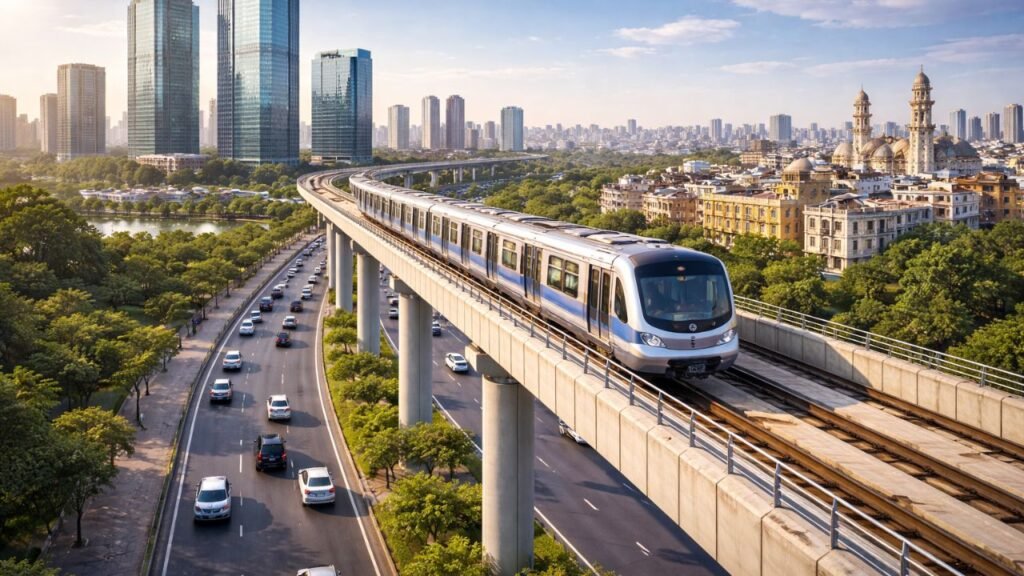
In a significant boost to urban connectivity, the Union Cabinet chaired by Prime Minister Narendra Modi has given the green light for a 3.33-kilometre extension of the Ahmedabad Metro’s North-South corridor. The new stretch will link GIFT City with Shahpur, strengthening transport links in Gujarat’s rapidly growing financial and residential zones.
The approval comes on the heels of the Phase II commissioning in January 2026 and reflects the government’s continued focus on expanding public transport infrastructure.
Key Project Details
Total Investment
The estimated cost for the project stands at ₹1,067.35 crore. The funding structure follows the existing model adopted for previous metro phases in Gujarat, ensuring financial continuity and streamlined implementation.
Infrastructure Plan
The extension will be a fully elevated corridor featuring three new metro stations. It will integrate seamlessly with the existing North-South alignment, allowing passengers to travel between Gandhinagar’s institutional areas and the financial district without disruption.
Implementation Agency
The Gujarat Metro Rail Corporation will execute the project. GMRC is a 50:50 joint venture between the Government of India and the Government of Gujarat, combining central resources with state-level execution expertise.
Project Snapshot
| Detail | Information |
| Length | 3.33 kilometres |
| Route | GIFT City to Shahpur |
| Type | Fully elevated corridor |
| New Stations | 3 |
| Estimated Cost | ₹1,067.35 crore |
| Implementing Agency | Gujarat Metro Rail Corporation |
| Expected Completion | Within 4 years |
| Target Operational Year | 2029–2030 |
Project Timeline
Construction activities are expected to begin after detailed design and tender approvals are completed. The estimated completion timeline is within four years, with the extension targeted to become operational by 2029–2030.
While four years may seem like a long wait, metro projects of this scale require careful planning, land coordination, structural work, and system integration before they can safely carry passengers.
Strategic Impact and Benefits
Enhanced Connectivity
The extension will bridge the international fintech hub at GIFT City with key residential and educational areas near Shahpur. The corridor also provides proximity to the Indian Institute of Technology Gandhinagar, making it particularly valuable for students and faculty.
Daily commuting for professionals working in the financial district, government employees stationed in Gandhinagar, and residents of developing neighborhoods along the route is expected to become significantly easier.
Ridership Projections
Officials have shared clear projections for passenger numbers based on traffic studies and growth patterns.
- Expected daily ridership by 2029: 23,702 passengers
- Projected daily ridership by 2041: Over 58,000 passengers
These numbers reflect long-term urban growth in the region and increasing reliance on public transport as the preferred mode of commuting.
Employment Generation
Infrastructure projects of this scale bring employment opportunities at multiple levels.
- Around 1,000 jobs during the construction phase across various roles
- Approximately 250 permanent jobs once operational for operations and maintenance
The project is also expected to boost allied sectors such as civil engineering, logistics, and services, creating a ripple effect in the local economy.
Real Estate Growth
Property experts anticipate a significant rise in real estate values in and around Shahpur due to improved metro connectivity. Estimates suggest a potential increase of 20 to 30 percent in property prices.
This “Metro Effect” has been observed consistently in cities where new corridors are announced. Areas within walking distance of stations typically see increased demand for both residential and commercial properties, attracting investment and development.
Key Benefits at a Glance
| Benefit | Details |
| Connectivity | GIFT City to Shahpur, near IIT Gandhinagar |
| Daily Ridership (2029) | 23,702 passengers |
| Daily Ridership (2041) | Over 58,000 passengers |
| Construction Jobs | Around 1,000 |
| Permanent Jobs | Approximately 250 |
| Real Estate Impact | 20-30% value increase expected |
Background: Phase II Commissioning
This approval follows the recent commissioning of Phase II of the Ahmedabad Metro in January 2026. That phase expanded services between key landmarks including:
- Motera Stadium
- Mahatma Mandir
- GNLU
- GIFT City
The new extension builds on this momentum, pushing connectivity deeper into areas that need it most. With each addition, the network becomes more comprehensive and useful for daily commuters.
Why This Matters
The expansion aligns with several broader policy objectives that extend beyond just moving people from point A to point B.
Urban Modernization Strategy – India’s cities are growing rapidly, and metro networks represent the most efficient way to move large numbers of people without adding to road congestion.
Promotion of Public Transport Usage – Every person who chooses the metro over a private vehicle contributes to reduced traffic and lower emissions.
Reduction of Traffic Congestion – Roads in the GIFT City area and along the corridor face increasing pressure from growing vehicle numbers. The metro offers an alternative that takes cars off the road.
Environmental Sustainability Goals – Mass transit systems have a lower carbon footprint per passenger kilometer compared to private vehicles. Expanding the metro supports broader climate commitments.
By linking GIFT City more efficiently with surrounding regions, the metro extension is expected to support economic activity and planned urban expansion in Gandhinagar and Ahmedabad. The financial district gains better connectivity with residential areas where its workforce lives. Students gain reliable access to educational institutions. Residents gain mobility options that don’t depend on personal vehicles.
For a region growing as fast as the Ahmedabad-Gandhinagar belt, that kind of connectivity isn’t just convenient – it’s essential.