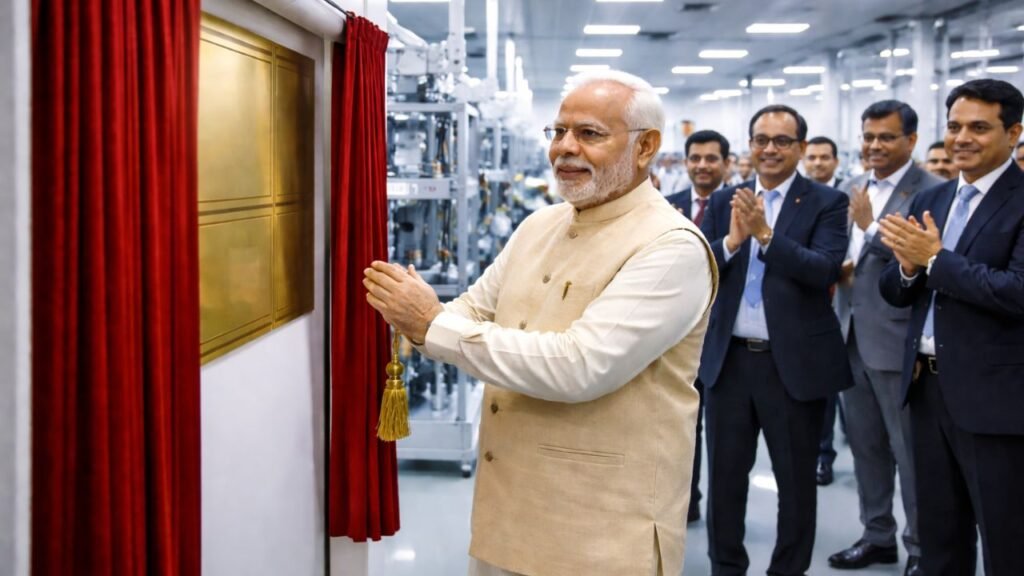
The road from Ahmedabad to Sanand has seen plenty of motorcades over the years. But on 28 February 2026, the crowd gathered on both sides wasn’t just there for a glimpse of the Prime Minister. They were there because something felt different this time.
When Narendra Modi stepped out to inaugurate the Micron Technology Semiconductor ATMP facility, he wasn’t just cutting a ribbon. He was signaling that India’s long struggle to become a serious player in global chip manufacturing might finally be turning a corner.
And the people watching? Many of them are hoping this corner leads straight to their doorstep.
What This Building Actually Does
Walk inside the facility and the first thing that hits you is the scale. Half a million square feet of cleanroom space. That number doesn’t mean much until someone explains it like this – imagine nine football fields, but every inch has to be thousands of times cleaner than a hospital surgery room. One stray dust particle during the wrong stage of production and entire batches of memory modules become worthless.
The plant takes DRAM and NAND wafers – those delicate silicon discs that currently travel across oceans to reach here – and turns them into the solid state drives that power everything from your laptop to massive data centers. Assembly, Test, Marking, Packaging. ATMP. Behind that alphabet soup is real work, done by real people, for global markets.
The total investment crosses ₹22,500 crore under the India Semiconductor Mission. That’s not announcement money. That’s committed, deployed, built.
The Jobs Conversation Everyone’s Having
Five thousand direct jobs. Fifteen thousand indirect. Those numbers get thrown around at every groundbreaking, every inauguration. But ask around Sanand and you’ll hear something different.
There’s a woman from a village near Mehsana who finished her electronics engineering two years ago. She’s been giving private tuition to school kids because there was nothing in her field close to home. She’s now shortlisted for a technician role here.
A man who runs a small eatery on the highway told me business has already picked up. Construction workers needed food. Engineers visiting from out of town needed places to eat. “If even half of what they’re saying happens,” he said, “I might need to hire someone.”
The indirect jobs aren’t just a number in a press release. They’re showing up in small ways already.
Why This Feels Different From Previous Announcements
India has announced semiconductor projects before. Groundbreakings with shiny shovels. MOUs signed under bright lights. Photo opportunities where everyone smiles and nothing happens afterward.
This one is actually running. Not next year. Not after the next election. Today.
The Sanand facility is producing memory modules. Real products. For real customers. That shift from announcement to execution is harder than it looks. Every country wants semiconductor manufacturing. Few pull it off.
The Neighborhood Is Changing
Sanand and Dholera are the two names you’ll hear repeatedly if you follow this space. The Micron plant is anchor tenant in what the state hopes will become a full-fledged chip ecosystem. OSAT facilities are in discussion. Wafer fabrication projects are being explored. Nothing public yet, but the people who track these things say inquiries have picked up noticeably since construction here progressed.
When you build one facility of this scale, you prove something. You prove the power grid can handle it. The water supply works. The logistics run. The workforce can be trained. Each proof point makes the next investor’s decision slightly easier.
A Moment That Stayed With Me
During the facility tour, someone asked a young engineer – probably in his late twenties, wearing the kind of cleanroom uniform that makes everyone look like they’re about to handle nuclear material – what it felt like to be part of this.
He thought for a second. Then he said: “My father spent thirty years working in a textile mill. Different industry, different time. But he always said the mills built modern Gujarat. Maybe we’re doing something like that here.”
It’s one line from one person. But walking out of that facility, it stayed with me. Because he’s right. These things compound. A plant opens. People get trained. Supply chains form. Expertise accumulates. Twenty years later, you have an industry that wasn’t there before.
What Monday Morning Looks Like
The inauguration is done. The speeches are over. Monday morning, the real work begins. Scaling production. Meeting quality targets. Training the next batch of technicians. Proving to the global semiconductor industry that India isn’t just a market but a serious manufacturing destination.
The Micron facility is one step. A big one, but still one. The question now is who follows.
For the young engineers in those rented apartments near Sanand, that question has a very personal answer. They’re hoping the answer is “many.” And if today is any indication, they might be right.
The chips manufactured here will eventually find their way into devices around the world. But for the people of Sanand, this facility isn’t about global supply chains. It’s about what happens in their own backyard. Finally.