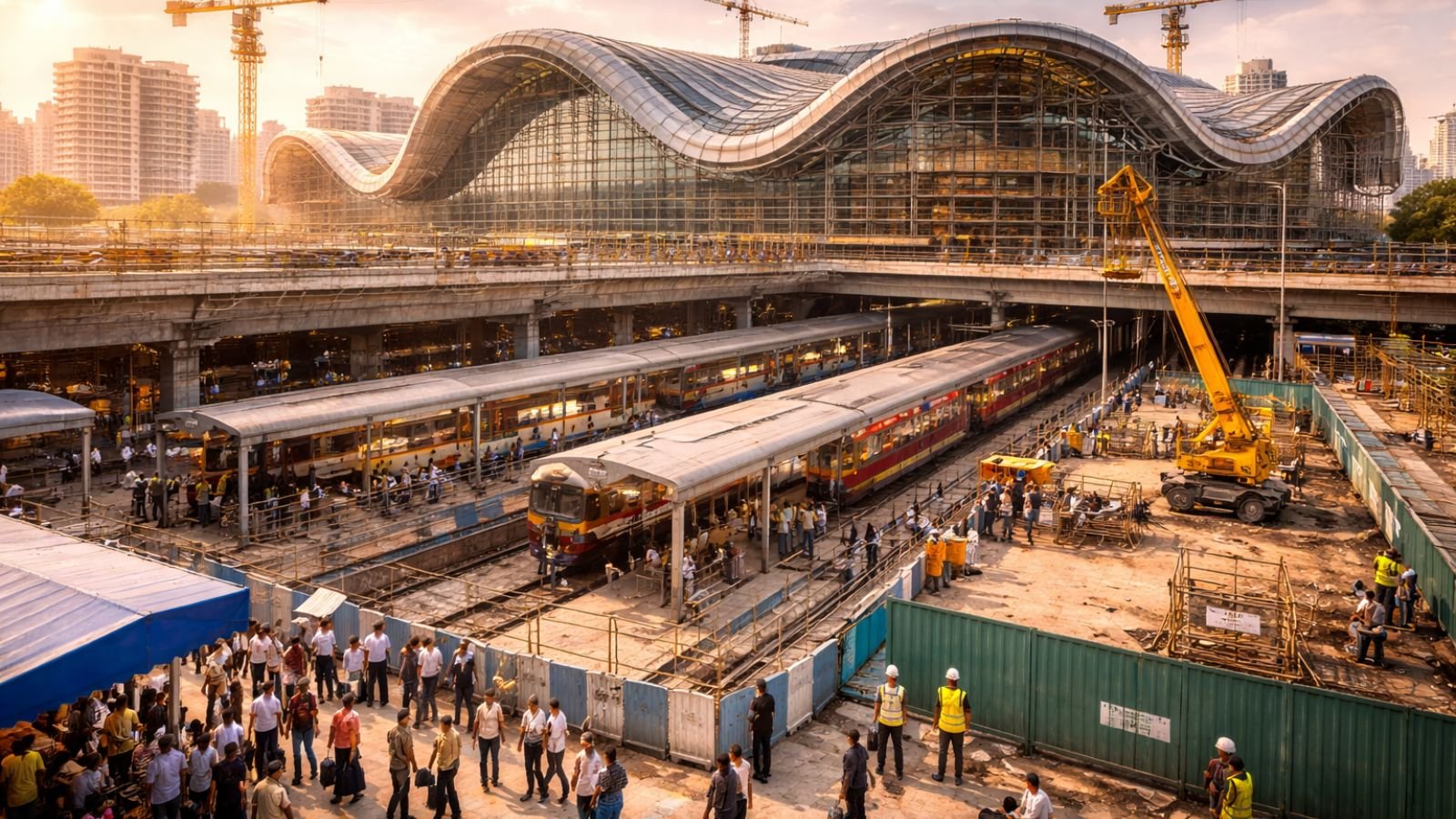
The redevelopment of Surat Railway Station into a modern Multi-Modal Transport Hub (MMTH) has entered a crucial phase in April 2026. With over 50% of Phase 1 completed, the project is steadily moving toward its goal of creating a fully integrated “Station City” by May 2027.
This transformation will connect rail, metro, and bus services into one seamless transport ecosystem. The Surat Railway Station Redevelopment 2026 is one of India’s most ambitious station transformation projects.
Current Construction Block (March–June 2026)
To enable large-scale structural work, a major operational block is currently in effect.
Key Details
- Start Date: 30 March 2026
- Duration: Around 90 days
- Purpose: Installation of a massive “through-roof” structure over platforms
Major Engineering Milestone
- Launching 41 girders (each 28.5 meters long)
- Using a 500 MT heavy crane
- Supporting a 145m × 85m elevated deck
This phase is one of the most technically complex parts of the entire redevelopment.
Impact on Train Services
Due to construction, several operational adjustments have been made, especially involving Udhna Junction. The railway station block impact has led to significant service changes.
Key Changes
Many trains are short-terminated or short-originated at Udhna, helping reduce congestion at Surat station.
Affected Services
- Bandra Terminus–Surat Intercity Express (12935): Short-terminated at Udhna (till April end)
- Surat–Amravati Superfast (20925/26): Partial operations via Udhna
- Tapti Line Trains: Halt shifted to Udhna instead of Surat
Continuity Maintained
Premium trains like Rajdhani, Shatabdi, and Vande Bharat continue operations, mostly handled via Platform 1.
Key Features of the New MMTH Hub
The ₹1,500 crore redevelopment is designed to redefine Surat’s transport infrastructure. This Surat MMTH will set new standards for railway stations in India.
Multi-Modal Integration
Direct connection with Surat Metro (Phase 1) and GSRTC bus terminal. Seamless movement between rail, metro, and road transport.
Passenger Facilities
- 10,900 sqm modern concourse
- 41 lifts and 70 escalators
- Fully Divyang-friendly infrastructure
Capacity Expansion
- New western-side station building
- Additional Platform 5 planned
- Designed to handle rising passenger traffic
Surat vs Udhna: Temporary Operational Shift
During the construction phase, roles of the two major stations have shifted. The Udhna Junction diversion strategy has helped manage passenger movement effectively.
Surat Railway Station
- Under major redevelopment
- Limited operations (Platforms 2, 3, 4 affected)
- Focus on long-term transformation
Udhna Junction
- Expanded to 5 functional platforms
- Acting as a temporary load-sharing hub
- Managing diverted and short-route trains
This temporary arrangement ensures minimal disruption despite large-scale construction.
What This Means for Passengers
Expect temporary inconvenience such as:
- Train diversions
- Platform changes
- Slight delays
Long-term benefits include:
- Faster transfers between transport modes
- Improved station infrastructure
- Better passenger experience
Conclusion
The redevelopment of Surat Railway Station into a Multi-Modal Transport Hub is one of India’s most ambitious station transformation projects. While the current construction phase brings temporary disruptions, it is laying the foundation for a future-ready transport hub.
With over 50% work completed and a clear timeline toward 2027, Surat is set to become a benchmark for modern railway infrastructure in India.
Frequently Asked Questions
Q1. What is the current status of Surat Railway Station redevelopment?
A1. As of April 2026, over 50% of Phase 1 has been completed. A major 90-day construction block started on 30 March 2026 to install a through-roof structure over the platforms.
Q2. How are train services being affected during the construction block?
A2. Many trains are short-terminated or short-originated at Udhna Junction. The Bandra Terminus–Surat Intercity Express is short-terminated at Udhna till April end, and Tapti Line trains have their halt shifted to Udhna.
Q3. Which premium trains continue to operate normally?
A3. Premium trains like Rajdhani, Shatabdi, and Vande Bharat continue operations, mostly handled via Platform 1.
Q4. What is the role of Udhna Junction during this period?
A4. Udhna Junction has been expanded to 5 functional platforms and is acting as a temporary load-sharing hub, managing diverted and short-route trains.
Q5. What will the new Multi-Modal Transport Hub (MMTH) include?
A5. The ₹1,500 crore MMTH will feature a 10,900 sqm concourse, 41 lifts, 70 escalators, Divyang-friendly infrastructure, direct connectivity with Surat Metro and GSRTC bus terminal, and an additional Platform 5.