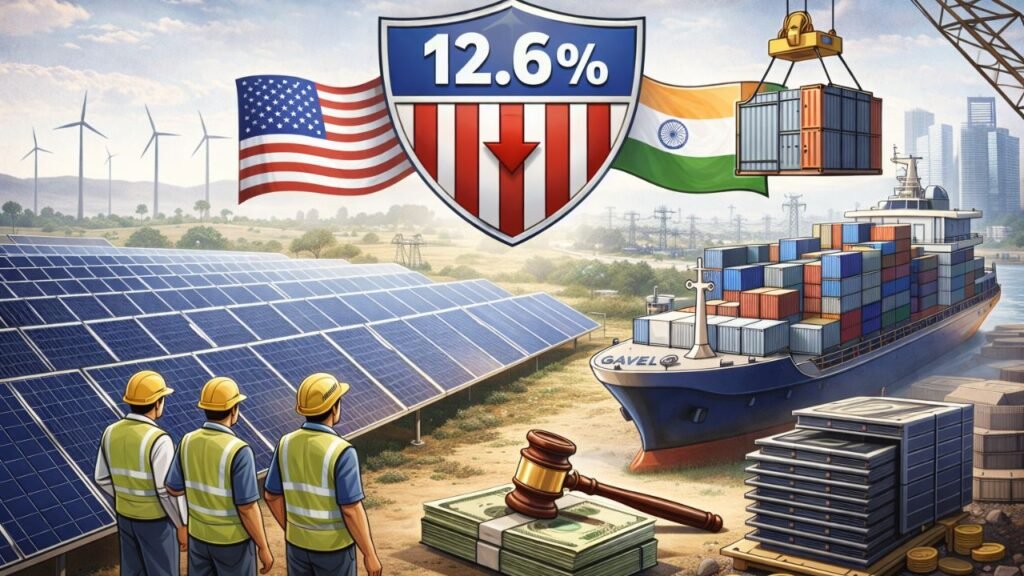
The United States Department of Commerce has dealt a significant blow to India’s solar export ambitions by imposing a 12.6 percent countervailing duty on crystalline silicon photovoltaic cells imported from India. The decision, announced recently, targets a sector where Gujarat holds a commanding position as the nation’s leading exporter to the American market.
Industry experts believe this move could reshape export strategies, investment flows, and supply chain structures in the coming years. For a state that has positioned itself as a renewable energy manufacturing powerhouse, the implications are substantial.
Impact on Gujarat’s Solar Ecosystem
Export Competitiveness Takes a Hit
Gujarat accounts for a substantial share of India’s solar module and cell exports to the United States. Manufacturing hubs in Ahmedabad, Mehsana, and Surat have built thriving businesses supplying the American market.
With the new 12.6 percent duty in place, the equation changes significantly:
- Indian-made solar cells become costlier for US buyers
- Price competitiveness weakens compared to US-based manufacturers
- Imports from countries not affected by similar duties gain relative advantage
For manufacturers operating on thin margins, this additional cost could make the difference between profitable exports and breaking even. Some may be forced to absorb part of the duty to retain customers, squeezing profitability further.
Key Impact Areas
| Factor | Implication |
| Export Margins | Expected to shrink due to additional duty |
| Price Competitiveness | Weakened compared to US domestic manufacturers |
| Market Position | Imports from unaffected countries gain advantage |
| Manufacturing Hubs | Ahmedabad, Mehsana, Surat face direct impact |
Market Diversification Becomes Urgent
With the American market becoming less accessible, manufacturers are now actively exploring alternative regions. The need to reduce dependence on any single export destination has become painfully clear.
Potential target markets include:
- European countries with growing renewable energy targets
- African nations seeking affordable solar solutions
- Middle Eastern markets with rising solar adoption
- The rapidly growing domestic rooftop solar segment in India
Companies are also strengthening their presence in India’s own renewable energy expansion programs. The domestic market, while competitive, offers scale and stability that exports cannot always guarantee.
Push for Supply Chain Localization
The duty has injected fresh urgency into efforts to build a more self-reliant solar manufacturing ecosystem in Gujarat.
Manufacturers are accelerating plans to:
- Produce solar ingots and wafers domestically instead of importing them
- Reduce reliance on imported raw materials from countries that may trigger future trade investigations
- Build integrated cell-to-module production facilities under one roof
This backward integration strategy serves a dual purpose. It reduces exposure to anti-subsidy investigations that target imported components, and it creates higher value addition within India, strengthening the case against future trade barriers.
Strategic Moves by Industry Players
Exploring US-Based Assembly Units
Some of the larger exporters are reportedly considering a more dramatic response – setting up assembly or manufacturing facilities within the United States itself. This approach, while capital-intensive, would allow them to bypass tariff barriers entirely by becoming local producers.
The strategy isn’t new. Several Indian companies in other sectors have taken similar paths when faced with persistent trade barriers. But for solar manufacturers, the high cost of setting up US operations and the complexity of navigating American regulations make this a decision not to be taken lightly.
Increased Focus on PM-Surya Ghar Scheme
Several Gujarat-based companies are redirecting supply toward India’s domestic rooftop solar expansion under the PM Surya Ghar: Muft Bijli Yojana. With export margins tightening, the high demand for residential solar installations in India presents a strong alternative revenue channel.
The government’s push for rooftop solar adoption creates a substantial market that can absorb production capacity previously earmarked for exports. For manufacturers willing to pivot, the domestic opportunity is significant.
Strategic Responses by Industry
| Strategy | Details |
| Market Diversification | Exploring Europe, Africa, Middle East |
| Domestic Focus | Targeting PM-Surya Ghar scheme |
| US Manufacturing | Considering assembly units in America |
| Supply Chain Integration | Local production of ingots and wafers |
Economic and Employment Implications
The short-term picture carries challenges that cannot be ignored.
- Export-oriented production faces pressure as orders may slow down
- Inventory adjustments may be needed as supply chains recalibrate
- Pricing recalibrations could squeeze margins across the value chain
However, the long-term view offers reasons for cautious optimism if the industry responds effectively.
- Strengthened domestic manufacturing reduces vulnerability to external trade actions
- New export destinations spread risk across multiple markets
- Higher value-added integrated production improves profitability per unit
Gujarat remains one of India’s strongest renewable energy manufacturing hubs. The state has built this position over years through policy support, entrepreneurial energy, and infrastructure investment. Policy responses at both state and central levels will now play a crucial role in determining the sector’s trajectory through this challenging period.
What Happens Next
Industry stakeholders are watching several developments closely.
Possible trade negotiations between India and the United States could potentially resolve or mitigate the duty if both sides reach an understanding. Trade disputes often have diplomatic components that play out alongside commercial impacts.
Additional anti-dumping or anti-subsidy measures cannot be ruled out. The US has shown willingness to use trade remedies across multiple sectors, and solar may not be the last.
Government incentives for domestic solar manufacturing could help offset some of the pain. If export markets become less attractive, strengthening domestic demand becomes even more critical.
The situation underscores a lesson that Indian exporters across sectors have learned repeatedly – dependence on any single market carries inherent risks. Diversifying export destinations and strengthening local supply chains aren’t just good strategies. They’re essential for long-term survival.
For Gujarat’s solar industry, the 12.6 percent duty is a setback, but not necessarily a defeat. How manufacturers respond over the next 12 to 24 months will determine whether this becomes a temporary bump or a lasting blow.