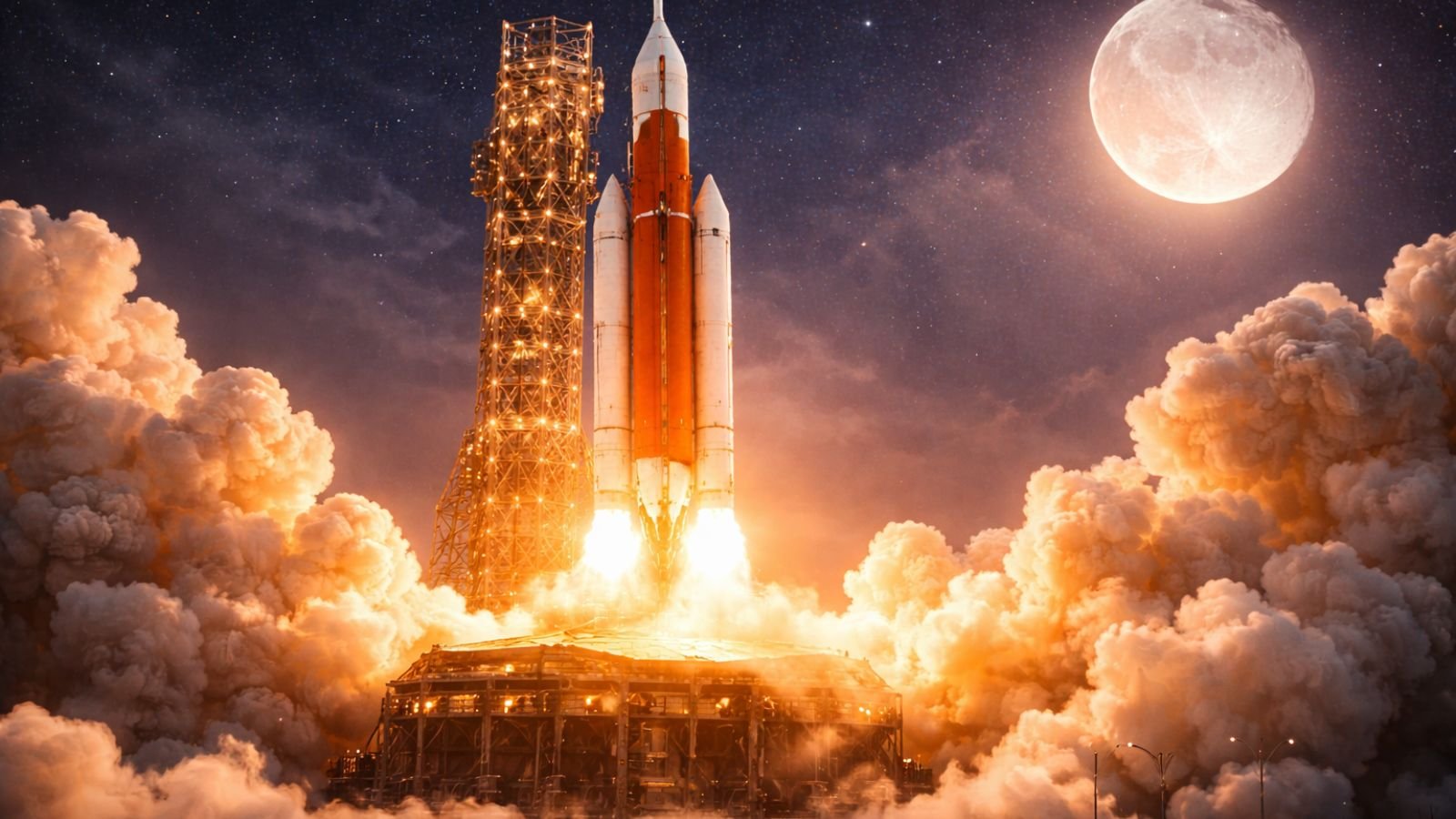
The Artemis II mission marks a historic step in human space exploration, bringing astronauts back to the Moon’s vicinity for the first time in over 50 years. Launched on April 1, 2026, this mission is part of NASA’s Artemis program aimed at advancing deep space exploration.
This article covers everything you need to know about the Artemis II Mission 2026, including its launch details, astronaut crew, mission timeline, current status, and future significance.
Quick Summary
- Mission Type: Crewed lunar flyby mission
- Launch Date: April 1, 2026
- Duration: 10 days
- Astronauts: Four crew members onboard
- Key Event: Lunar flyby on April 6, 2026
- Return: Planned splashdown on April 10, 2026
Current Situation / Overview
Mission Launch and Objective
Artemis II successfully launched on April 1, 2026, marking the first crewed mission of the Artemis program. This NASA lunar mission aims to send four astronauts on a journey around the Moon and safely return them to Earth.
Mission Progress
As of April 4, 2026, the spacecraft has already spent nearly 48 hours in space and is progressing steadily toward the Moon.
Current Location
The Orion spacecraft, named Integrity, has passed the midpoint between Earth and the Moon, indicating that the mission is well on track.
Detailed Mission Timeline and Analysis
Launch Phase
The mission lifted off from Kennedy Space Center’s Launch Complex 39B at 6:35 p.m. EDT on April 1, 2026. This marked the beginning of a historic deep space journey.
Earth Orbit Phase
During the first two days, the spacecraft performed multiple engine burns to raise its orbit and complete critical system checks.
Lunar Flyby
On April 6, 2026, Artemis II is scheduled to reach the Moon and perform a close flyby. The spacecraft will approach approximately 7,600 km from the lunar surface.
Record Distance
During the mission, the crew is expected to travel up to 406,773 km from Earth, setting a new record for human spaceflight distance.
Splashdown
The mission is scheduled to conclude with a splashdown in the Pacific Ocean near San Diego, California, on April 10, 2026.
Mission Status & Current Operations
Spacecraft Trajectory
Following a successful Translunar Injection (TLI) burn on April 2, the spacecraft is now on a free-return trajectory. This path uses the Moon’s gravity to guide the spacecraft back toward Earth without requiring major additional engine burns.
Recent Activities
The crew successfully completed a proximity operations demonstration early in the mission. This involved manually maneuvering the spacecraft near the spent rocket stage to test handling capabilities.
The Historic Crew
The Artemis II astronauts represent significant milestones in space exploration:
- Reid Wiseman – Mission Commander on his second spaceflight
- Victor Glover – First person of color to travel beyond low Earth orbit
- Christina Koch – First woman assigned to a lunar mission
- Jeremy Hansen – First non-U.S. astronaut on a lunar mission
Key Technology and Science Behind the Mission
Launch Vehicle
The mission uses the Space Launch System (SLS), currently the most powerful operational rocket in the world.
Spacecraft
The Orion capsule, paired with the European Service Module (ESM), provides life support, propulsion, and power for the crew.
Scientific Experiments
- AVATAR: Studies radiation and microgravity effects on human health using organ-on-chip technology
- O2O: Tests high-speed laser-based communication systems for faster data transmission
Secondary Payloads
Five international CubeSats are onboard to study space weather and radiation conditions.
Environmental and Operational Risks
Communication Blackout
During the lunar flyby, the crew may experience a communication blackout with Earth lasting between 30 to 50 minutes.
Deep Space Challenges
Operating beyond low Earth orbit introduces challenges such as radiation exposure and limited real-time communication.
Who Should Follow This Mission Closely
- Space Enthusiasts: This mission represents a major milestone in returning humans to deep space exploration
- Science and Technology Followers: The advanced systems and experiments onboard provide valuable insights into future space missions
- Students and Researchers: Artemis II offers real-world data and inspiration for those studying aerospace, physics, and engineering
Practical Insights and Key Takeaways
Why Artemis II Matters
Artemis II is not just a mission – it is a foundation for future lunar landings and long-term space exploration.
What Makes It Historic
- First crewed lunar mission in over 50 years
- Diverse astronaut team
- Advanced spacecraft and communication technologies
What to Expect Next
The mission will pave the way for future Artemis missions aimed at landing humans on the Moon again.
Future Outlook
Artemis II serves as a critical precursor to upcoming missions. Artemis III, planned for 2027, will involve further crewed operations, while Artemis IV, expected in 2028, aims to return humans to the lunar surface.
Final Outlook
The Artemis II mission in 2026 marks a defining moment in modern space exploration. From its successful launch to its upcoming lunar flyby, the mission demonstrates humanity’s renewed ambition to explore deep space.
With cutting-edge technology, a historic crew, and a carefully planned trajectory, Artemis II is setting the stage for the next era of lunar exploration.
Frequently Asked Questions
Q1. When did Artemis II launch and when will it return?
A1. Artemis II launched on April 1, 2026, and is scheduled to splashdown on April 10, 2026, after a 10-day mission.
Q2. Who are the four astronauts on the Artemis II mission?
A2. The crew includes Reid Wiseman (Commander), Victor Glover, Christina Koch, and Jeremy Hansen.
Q3. How close will Artemis II get to the Moon?
A3. The spacecraft will perform a lunar flyby at approximately 7,600 km from the lunar surface on April 6, 2026.
Q4. What is the Orion spacecraft?
A4. Orion is the crew capsule used for the Artemis II mission, paired with the European Service Module for life support, propulsion, and power.
Q5. What makes the Artemis II mission historic?
A5. It is the first crewed lunar mission in over 50 years, features a diverse astronaut team, and includes the first person of color and first woman assigned to a lunar mission.